Average US breach cost reached $11.5M in IBM's 2026 report. A plan's value depends on data visibility, role assignments, escalation authority, legal preparation, tooling, and testing.
This guide covers scope, decision rights, the first-response workflow, US notification obligations, the variables that drive quality, and the mistakes that sink responses.
Key Takeaways
- Name people, backups, decision rights, severity thresholds, and channels for every stage.
- Confirm and scope the breach first, while containing exposure and preserving evidence.
- US notification duties vary by data, industry, contract, and state, so build legal review in.
- Test contacts, containment actions, templates, and recovery, then measure them.
- Give boards plain-English reporting: material risk, decisions needed, trend, readiness.
How to Create a Data Breach Response Plan
Step 1: Define scope, breach triggers, and objectives
Start with vocabulary. Define a security event, incident, suspected breach, confirmed breach, and reportable breach. Then attach severity levels that decide who gets called.
Definitions differ by law. NIST SP 800-61r3 (2025) treats an incident as an occurrence that jeopardizes confidentiality, integrity, or availability. HIPAA presumes an impermissible PHI disclosure is a breach unless a risk assessment shows low probability of compromise. An operational incident is not automatically a notifiable breach.
Before anything happens, map:
- Sensitive data categories and the systems holding them
- Data owners, third parties, and affected populations
- Jurisdictions where affected people live
Set objectives: limit harm, preserve evidence, keep essential operations running, meet notification duties, and document defensible decisions. Align lifecycle terms with NIST (or ISO/IEC 27035), then tailor to your environment. Separate data-exposure incidents from availability-only events such as an outage with no data access.
Step 2: Build the response team and assign decision rights
Name a primary and a backup for each role:
- Incident coordination and technical investigation
- Legal and privacy review
- Communications and HR
- Compliance and vendor management
- Executive oversight and business continuity
Then document who can:
- Isolate a system, disable an account, or rotate credentials
- Hire forensics and contact insurers or law enforcement
- Approve customer notices and authorize public statements
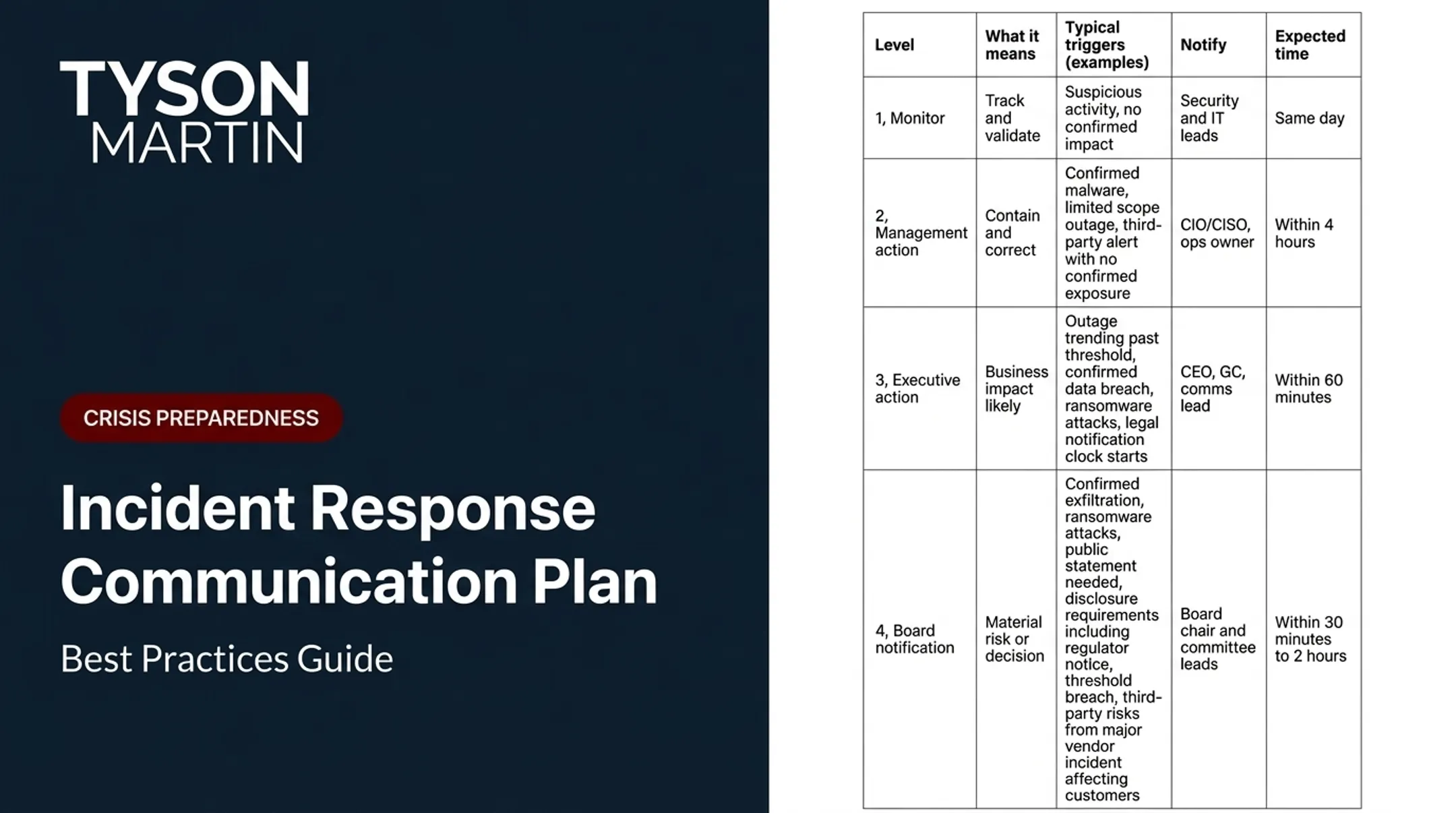
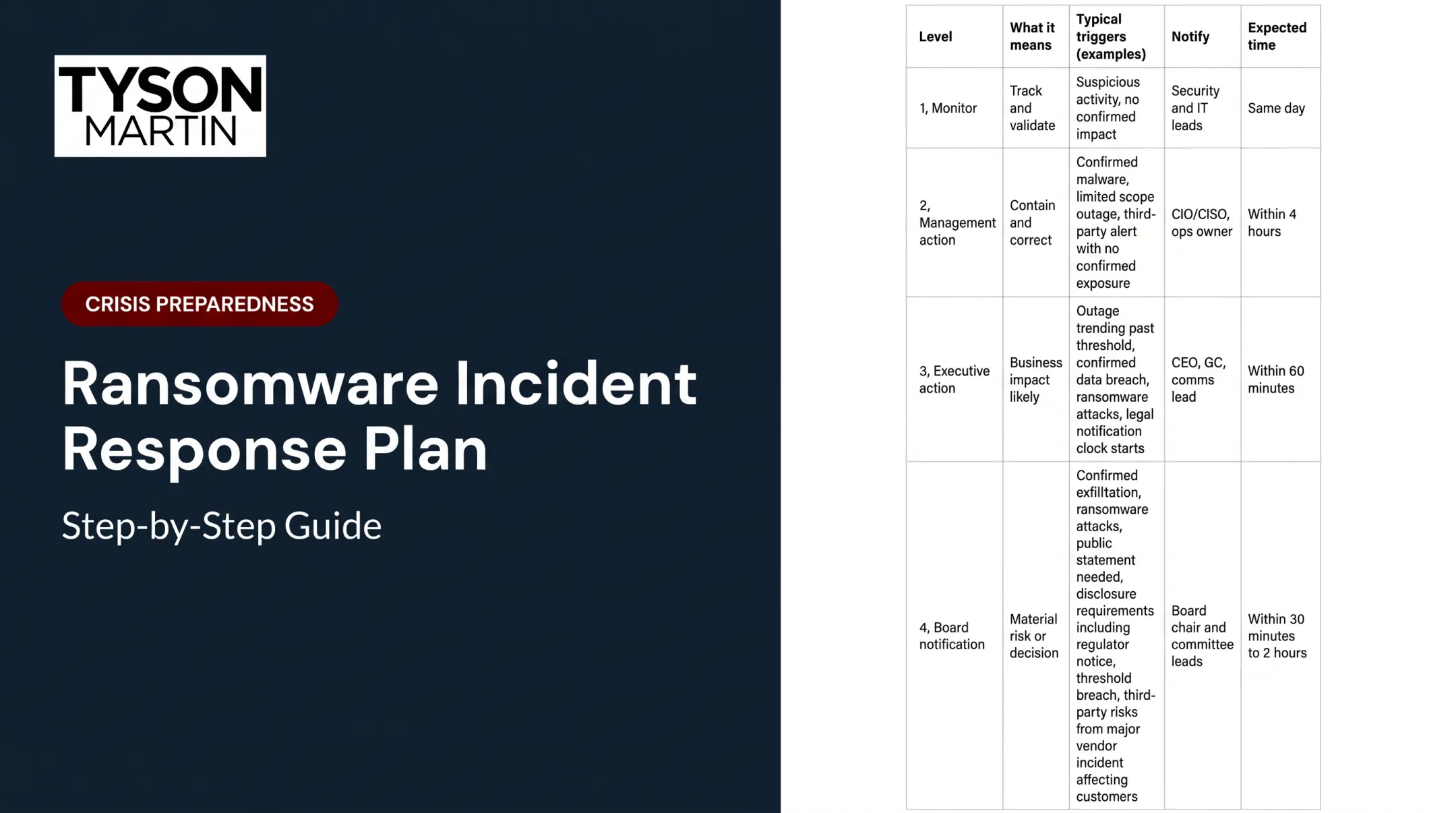
A practical escalation ladder helps. One model:
- Monitor-level activity: security and IT the same day
- Confirmed malware: CIO or CISO within 4 hours
- Confirmed breach with likely business impact: CEO and legal counsel within 60 minutes
- Material risk: board chair within 30 minutes to 2 hours
Add out-of-band contacts, such as personal phones or a separate chat tool, in case corporate email or identity systems are compromised. Retest the contact list after reorganizations, leadership changes, acquisitions, and major technology changes.
Tyson Martin's advisory work centers on exactly this: decision rights and escalation thresholds that hold up in real incidents.
Step 3: Document the first-response workflow
Write an ordered checklist: detection, triage, containment, scoping, evidence preservation, and documentation. Each step should say what to record.

Capture:
- Time and source of discovery
- Affected accounts and devices
- Suspected data types and indicators of compromise
- Actions taken and open questions
Containment and evidence pull against each other. The FTC advises taking equipment offline but not powering machines off before forensic experts arrive. NIST SP 800-86 says to collect volatile data before shutdown, weighing risk against evidence value.
Specify who can authorize remote actions, and how the team confirms that a lock, wipe, or credential change actually executed. Use one secure incident log and one communication channel. Ban informal or unreviewed statements, which create inconsistent messaging and can compromise the investigation.
Step 4: Plan notification, recovery, and post-incident improvement
Map each possible obligation (federal, state, sector, contractual, insurance) to an owner, decision threshold, deadline source, and approval path. Legal and privacy teams should verify current requirements for the data and jurisdictions involved rather than rely on one generic deadline.
The clocks start at different events:
| Rule | Deadline | Trigger |
|---|---|---|
| HIPAA | 60 days | Discovery |
| FTC Safeguards Rule | 30 days (FTC notice, 500+ consumers) | Discovery |
| Banking agencies | 36 hours | Determination of a notification incident |
| SEC Item 1.05 | 4 business days | Materiality determination |
| NYDFS 500.17 | 72 hours | Determination of a qualifying incident |
State laws add more. Colorado requires resident notice within 30 days of determining a breach occurred, even where HIPAA allows 60. Wisconsin uses 45 days.
Prepare templates for executives, employees, individuals, regulators, vendors, insurers, law enforcement, and media. Define eradication, clean restoration, heightened monitoring, and business-resumption criteria so systems do not return to production early. Finish with a post-incident review recording the timeline, failed assumptions, metrics, unresolved risks, and owners with due dates.
When Should You Create a Data Breach Response Plan, and What Do You Need?
Build it before an incident. Review it after major business or technology changes, and update it after every exercise or real event. Drafting during a crisis is too late.
When a formal plan is especially important
Go formal and cross-functional if you:
- Hold personal, financial, health, payment, employee, or regulated data
- Depend on critical vendors
- Operate in multiple states
- Cannot tolerate extended disruption
Third parties were involved in 48% of breaches in Verizon's 2026 DBIR. Organizations in M&A, cloud migration, leadership transition, or rapid growth need extra attention. The FTC's 2024 Marriott complaint alleges the Starwood intrusion began in 2014, before the 2016 acquisition, and went undetected until 2018.

A small organization can use a lighter playbook. Lean staffing still requires named authority, legal escalation, evidence handling, and tested communications.
What you need first
- Current asset and data inventory with a classification scheme
- System and vendor map, plus business-impact priorities
- Contact list and a secure communications method
- Logging capability, log retention periods, and backup details
- Insurance details and applicable legal or contractual requirements
- Legal, privacy, technical, communications, HR, executive, and forensic contacts, with after-hours backups
Confirm what evidence you can preserve and whether actions like account suspension or isolation can be verified. If you have no dedicated incident leader, Tyson Martin offers board advisory and interim or fractional CISO support to clarify decision rights, build a practical plan, and test execution. Interim leadership only works when the organization will actually assign decision rights.
Alternatives to a standalone plan
- Integrated incident response, continuity, and disaster recovery framework. Best when a mature enterprise program exists. It cuts duplication, but privacy notification duties get harder to find unless the breach workflow is a clear annex.
- External retainer or fractional cyber leader. Best when expertise, after-hours coverage, or forensics is thin. It adds capacity but does not replace internal data ownership, decision authority, or pre-approved access.
- Scenario-based playbook. Best for small teams where a long policy would go unread. It must still cover legal review, evidence, communications, recovery, and named backups.
Key Parameters That Affect Data Breach Response Quality
Outcomes depend less on page count than on whether a few variables are accurate, current, and testable.
Severity and activation thresholds
Blurry lines between an alert, incident, suspected breach, and reportable breach delay the right people. Practical thresholds set response speed, resource allocation, executive visibility, and the moment legal review begins.
Data visibility and scope
Notification, containment, and recovery all depend on knowing which systems, records, accounts, vendors, and people are affected.
NIST's 2025 profile calls for inventories of data classification, owners, and locations. The FTC alleged that Marriott's inadequate logging made it hard to separate authorized activity from attacker activity and to determine what was exfiltrated.
Decision rights and escalation paths
Technical teams often spot the problem but cannot isolate production, hire forensics, or approve spend. A simple fix:
- Pre-approve a dollar threshold management can spend immediately
- Name who signs
- Name a backup signer
Awareness is not enough either. Per the SEC's Altaba order, Yahoo's security staff learned of the 2014 intrusion within days and it reached management and legal, yet the disclosure assessment was inadequate. Public disclosure came in 2016, and the company paid $35M.

Containment and evidence-preservation sequence
Define default actions, exceptions, forensic and legal consultation, and chain-of-custody expectations. DOJ guidance calls for:
- Bit-for-bit copies
- Write protection
- Restricted access
- Preserved logs Specify how the team verifies containment without erasing evidence.
Notification readiness and communication control
Build these before an incident:
- Jurisdiction matrix
- Pre-approved templates
- Communications owner
- Counsel review The FTC warns against misleading statements and withholding important details. Initial messaging can say scope may involve a stated range of records and remains subject to change, without overstating unconfirmed facts.
Common Mistakes and Troubleshooting a Data Breach Response Plan
Most failures come from stale assumptions, unclear authority, poor sequencing, or missing evidence, not from skipping a familiar phase.
Skipping preparation or relying on a stale plan
Likely cause: outdated contacts, incomplete inventories, unknown data owners, untested backups, expired vendor details, or a plan stored on a system responders cannot reach during an incident.
Fix:
- Verify the plan after every organizational or technology change
- Confirm primary and backup contacts
- Run a short activation drill
- Assign owners and due dates to every gap
A 2020 IBM study found 74% of organizations had ad hoc, inconsistent, or no plans, and half of those with plans had never reviewed them. The pattern still holds.
Choosing containment that destroys evidence or fails to stop access
Likely cause: wiping a device before imaging it, disabling a directory account while cached credentials remain active, or restoring from an unverified backup.
Fix:
- Confirm the forensic-preservation decision tree
- Validate session and token invalidation steps
- Apply clean-backup criteria before restore
- Capture remote-action logs and enhance monitoring after recovery
The FTC notes that removing attacker tools does not cure stolen credentials. NIST requires verifying backup integrity before restoration.
Delaying escalation and notification decisions
Likely cause: ambiguous thresholds, fragmented alerts, informal chatter, uncertainty about affected data, and waiting for certainty before calling legal or executives.
Fix:
- Review detection-to-escalation timing
- Define when suspected exposure triggers counsel and incident leadership
- Centralize one incident timeline
- Report to the board in a format that separates confirmed facts, assumptions, risks, and decisions needed
Conclusion
A response plan works when it turns uncertainty into pre-approved decisions about authority, containment, evidence, notification, recovery, and communication. A strong plan stays current, accessible, tested, and measurable, and it maps to your real data and environment rather than to document length.
This week:
- Verify response contacts, including backups.
- Identify the three incident decisions that need authorization, and who holds each.
- Test one technical containment action, such as revoking sessions for a test account.
- Schedule a tabletop exercise with legal, communications, IT, and an executive.
Frequently Asked Questions
What are the steps to respond to a data breach?
Detect and triage, activate the response team, contain, preserve evidence, assess scope, get legal review, notify where required, eradicate, recover, and run a post-incident review. Several of these overlap in practice.
What is the first step in a data breach response?
Record the report or signal, activate the right response process, preserve initial evidence, and start confirming scope. Don't wait for every fact before acting.
What should a data breach response plan include?
Definitions and severity thresholds, named roles and backups, decision rights, detection and containment procedures, evidence handling, legal and notification workflows, communications templates, recovery criteria, and a testing schedule.
What is a data breach response plan?
A documented, tested set of decisions and procedures for managing suspected or confirmed unauthorized access, disclosure, alteration, loss, or destruction of sensitive data.
What is an example of a potential breach?
A stolen laptop, exposed database, compromised account, misdirected email, insider snooping, or vendor incident. Investigation determines whether protected data was actually exposed.
What is a breach of data protection?
Generally, accidental or unlawful loss, destruction, alteration, unauthorized disclosure, or unauthorized access to protected personal information. The precise definition depends on the applicable US law or regulation.