Cyber resilience is the ability to continue or restore important financial services while managing the operational, financial, regulatory, and trust consequences of a cyber incident. It differs from cybersecurity and from operational resilience, though the three overlap.
This article separates those concepts, walks through six practical pillars, and gives boards and executives a way to test whether resilience exists beyond policies and audit evidence.
Key Takeaways
- Resilience is measured by how well critical services continue or recover, not by blocking every attack.
- Governance, technology, response, continuity, third-party risk, and recovery testing must work as one system.
- A compliant control or written plan proves little until it works under realistic conditions.
- Boards need plain-English reporting on service impact, residual risk, trends, and decisions required.
What Does Cyber Resilience Mean in Financial Services?
Cyber resilience is an outcome, not a tool
For banks, credit unions, insurers, investment firms, fintechs, and payment providers, the goal is to prevent, withstand, contain, respond to, recover from, and learn from cyber disruption while services keep running. NIST describes cyber resiliency as the ability to anticipate, withstand, recover from, and adapt to attacks and compromises.
Think about online banking, card payments, settlement, lending, trading, claims processing, customer authentication, and regulatory reporting. In each, availability and integrity matter as much as confidentiality. A payment that posts twice or a claim that cannot be processed is a failure even if no data leaked.
Three related but different ideas
- Cybersecurity protects systems and data.
- Cyber resilience keeps services operating through cyber disruption and restores them afterward.
- Operational resilience covers the broader ability to deliver critical operations through any failure: technology, people, facilities, vendors, or events.
Business continuity and disaster recovery sit inside this model. The FFIEC's business continuity guidance treats disaster recovery as restoring IT, data, and systems. Incident response handles the immediate event and limits service disruption and information loss. Resilience is the wider capability around both.
What "resilient" looks like
Observable signs include:
- Critical services identified and dependencies documented
- Clear decision rights
- Tested fallback procedures
- Prepared communications plans
- Documented recovery evidence
Resilience does not mean zero incidents or zero downtime. It means the institution knows what disruption it can tolerate, limits the blast radius, decides quickly, and improves afterward.
Why compliance alone is not proof
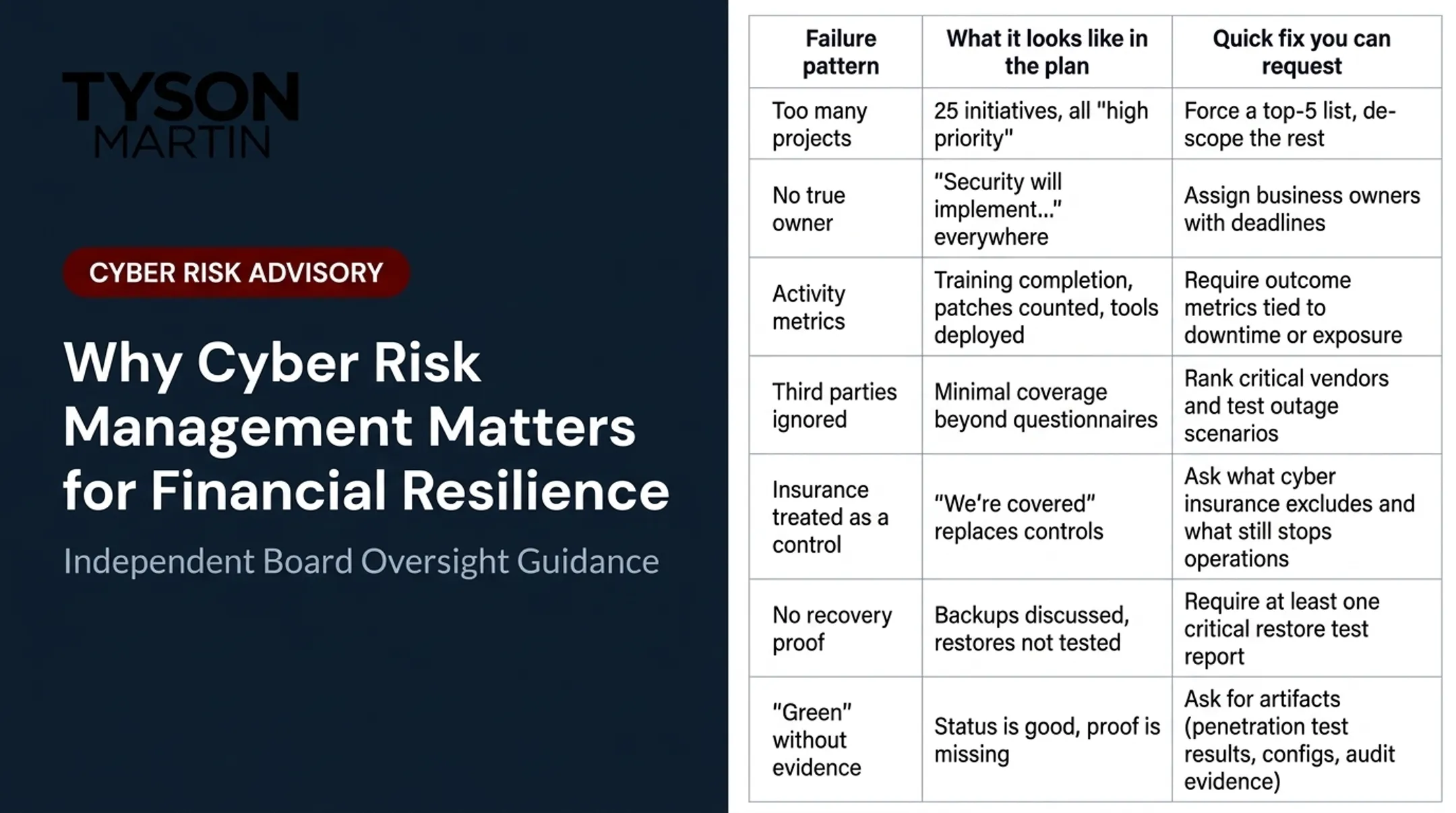
Having a policy, passing an assessment, or closing a ticket is different from showing that a customer-facing service can recover. The same gap shows up often: compliance status does not prove fast detection and recovery. Better evidence includes tested restores, tabletop outcomes, and trend metrics tied to business impact.

Applicability also varies. The interagency Sound Practices paper targets large firms (at least $250B in average assets, or at least $100B with specified risk indicators) and creates no new regulation. The NIST Cybersecurity Framework is voluntary. No single framework applies identically to every institution, so confirm what applies to yours.
Why Cyber Resilience Matters in Financial Services
Customers and markets depend on these services
Disruption can block access to funds, payments, settlements, lending decisions, trading, claims, and customer support. Those services are time-sensitive, so outages quickly become customer and market events.
In 2023, ransomware hit ICBC Financial Services, a US broker-dealer. Per the SEC order, the firm lost access to books and records, disconnected from clearing firms, and saw trading impeded. The findings concern the US broker-dealer, not the wider ICBC group.
The attack surface is interconnected
Legacy platforms, cloud infrastructure, APIs, mobile apps, identity systems, call centers, data providers, payment networks, and outsourced technology all connect. A compromise in one place can bring fraud, data exposure, degraded service, or messy recovery elsewhere.
Evolve Bank & Trust is a documented case. Its incident affected bank customers and customers of its Open Banking partners. That shows interconnected exposure, though not proof that attackers entered partner networks.
Third-party and concentration risk becomes service risk
Resilience reviews must include cloud providers, managed security providers, core processors, payment vendors, fintech partners, and software suppliers. The 2023 interagency third-party guidance points to practical review areas:
- Dependencies and single-provider concentration
- Service-level expectations
- Incident notification timelines
- Recovery plans, RTO/RPO, and joint testing
- Subcontractor activities and locations
- Exit and transfer planning
The FSOC's 2025 annual report notes that incidents at major providers can affect many institutions, especially where substitutes are limited. A simple question helps: which vendor outage would stop revenue within 24 hours, and what is the workaround?
Board and executive responsibility
Boards and executives approve risk appetite, understand critical services, assign accountable owners, and make trade-offs among security, availability, speed, cost, and customer impact.
Tyson Martin's advisory work centers on this: clear decision rights, plain-English reporting, escalation thresholds, and decisions a board can defend. This is governance advice, not regulatory or legal counsel.
The cost of failure goes beyond technical damage
Failure costs stack quickly:
- Customer harm and fraud
- Financial loss, contract disputes, and litigation
- Regulatory scrutiny
- Reputational damage and lost market confidence
IBM's 2026 study puts the average financial-sector breach at $6.29M, though its sample is nonstatistical and global. Sophos surveyed financial-services leaders and reported a $1.74M mean ransomware recovery cost, excluding ransom.

The Six Pillars of Cyber Resilience for Financial Services
NIST CSF 2.0 gives a useful organizing model of six functions. It describes outcomes, is voluntary unless adopted through policy or mandate, and is not a universal legal checklist.
Govern: establish accountability
Governance sets risk appetite, assigns ownership, defines escalation thresholds, approves exceptions, and ties cyber risk to critical business services. Two practical tools help:
- A one-page appetite statement defining unacceptable impacts
- A one-page escalation ladder with triggers, notification paths, and expected response times
Both should be reviewed as products, revenue, and obligations change.
Identify: understand services and dependencies
List important business services, then the applications, data, identities, facilities, and vendors behind them. An asset inventory is not enough. Resilience requires knowing which components must work together for a service to function.
A fast start: list the top 10 systems and datasets, and mark those that could stop revenue within 24 hours.
Protect: reduce likelihood and impact
Core controls to prioritize by business criticality and attack path:
- Identity and access management, least privilege, and phishing-resistant MFA where appropriate
- Encryption, secure configuration, and network segmentation
- Vulnerability management guided by CISA's Known Exploited Vulnerabilities catalog
- Offline, encrypted, regularly tested backups
- Workforce awareness
NIST SP 800-63B-4 requires a phishing-resistant option at AAL2 and phishing-resistant authentication at AAL3, but that is not a blanket financial-sector mandate.
Detect: find meaningful signs early
Monitor identities, endpoints, networks, applications, cloud, transactions, and third parties. Tie alerts to business impact. The test is not alert volume. Can you spot abnormal activity early enough to isolate a critical service?
Respond: coordinate under pressure
Security, technology, operations, fraud, legal, compliance, communications, executives, and business owners all have roles. Playbooks should cover:
- Escalation criteria and evidence preservation
- Containment and service prioritization
- Customer and regulator communications
- Controlled emergency change procedures
Recover and adapt: restore and improve
Recovery needs tested backups, restoration priorities, alternate procedures, and data integrity checks. Validate that the service works, not just the underlying system. After every exercise or incident, assign owners and deadlines for lessons learned, and record any risk acceptance. CSF 2.0 keeps six functions; adaptation happens through continuous improvement across the program, not a separate seventh pillar.

What Cyber Resilience Looks Like in Practice
Before an incident
Preparation is visible and testable. A mature institution has current critical-service maps, named owners, documented dependencies, tested recovery, vendor contacts, communication plans, and clear decision thresholds.
Run scenario exercises: ransomware, identity compromise, cloud outage, payment processor failure, data corruption, or simultaneous third-party disruption. A 60-minute tabletop with a CEO delegate, IT, product, legal, and communications is a workable start. If you cannot describe your first two hours of response, you do not have a plan yet.
During an incident
Picture a compromised vendor credential that affects a customer-facing payments service. Leaders must weigh containment against customer access, protect transaction integrity, track regulatory clocks, and sequence restoration.
Pre-decide who can:
- Isolate systems
- Approve emergency changes
- Accept temporary risk
- Speak externally
- Brief the board chair
Notification clocks differ by entity. Banking organizations notify their primary federal regulator within 36 hours of determining a notification incident occurred. Credit unions have 72 hours. SEC reporting companies file Form 8-K Item 1.05 within four business days of a materiality determination.
After an incident
Do not declare success when systems merely come back online. Validate service functionality, data integrity, access controls, transaction processing, monitoring, and customer communications.
Useful measures, each defined plainly:
- Time to detect: how long until the compromise is identified
- Time to contain: how long until spread is stopped
- Time to restore a critical service: how long until customers can use it
- Recovery-test success: share of tests that meet targets
- Unresolved high-impact dependencies: known gaps still open
- Remediation-induced disruption: outages caused by fixes
Benchmarks are thin. M-Trends 2026 reports a global median dwell time of 14 days, and IBM reports a 247-day combined identification and containment mean. Neither is a restoration target, and comparable US financial-sector benchmarks for recovery-test success are hard to find. Set targets from your own impact analysis.

How Financial Institutions Build and Govern Resilience
Start with critical services and a 90-day plan
Pick a few high-impact services, map dependencies, find the biggest gaps, assign owners, and sequence fixes by customer and business impact.
- Days 1-30: Discovery. Map services, data, top vendors, and dependencies. Establish a baseline covering MFA, privileged access, logging, backup testing, runbooks, and vendor-access review.
- Days 31-60: Decisions. Set risk appetite, escalation ladder, and restore priorities. Run a tabletop.
- Days 61-90: Remediate and report. Close top gaps, retest recovery, and deliver the first executive scorecard.
Treat this as a structure, not a promise of validated results.
Report for decisions, not noise
A stable dashboard tracks a short set of decision-ready signals:
- What changed since the last review
- Residual risk and critical-service readiness
- Overdue decisions and material exceptions
- Third-party exposure and exercise outcomes
- Trend lines marked improving, stable, or worsening, each with a short reason
Add a "decisions requested" box with one to three items, each with options and a recommended path. That keeps board and executive time on choices, not slide noise.
Tyson Martin provides board advisory and interim or fractional CISO support when institutions need clearer decision rights, tighter executive reporting, and cyber findings turned into inspectable execution.
Make resilience continuous
Fold resilience into the operating rhythm, not a side program:
- Enterprise risk management and internal audit
- Change management, budgeting, and board calendars
- M&A diligence and vendor reviews
- Incident reporting and escalation
NIST IR 8286 Rev. 1 describes rolling cyber risk registers into enterprise registers and comparing them with risk appetite.
The practical test is whether leaders can answer five questions without a scramble:
- Which services matter most?
- What could interrupt them?
- Who decides during disruption?
- How will recovery be proven?
- Which unresolved risks need an explicit decision?
Frequently Asked Questions
Why is cyber resilience important in financial services?
Financial institutions support essential, interconnected services. When prevention fails, they must limit customer, market, financial, regulatory, and reputational harm.
What does cyber resilience mean in financial services?
It is the ability to prevent, withstand, contain, respond to, recover from, and learn from cyber incidents while maintaining or restoring critical financial services.
What does resilience mean in finance?
It is the continued delivery of important financial functions despite disruption from cyber events, technology failures, third parties, or other operational risks.
What are the pillars of cyber resilience in financial services?
Govern, Identify, Protect, Detect, Respond, and Recover. Adapt them to your institution's critical services and risk profile.
What are the pillars of operational resilience in the financial sector?
The interagency Sound Practices cover governance, operational risk management, business continuity, third-party risk management, scenario analysis, secure and resilient information systems, and surveillance and reporting.