Confusing them is expensive. Containment stalls while people argue over who decides. Employees, customers, regulators, and the board hear different versions of the story. IBM's 2026 research puts the average US breach at $11.5M, a benchmark that shows what unclear ownership can compound.
This article compares the two functions, shows when each leads, and explains how to wire them together before something breaks.
Key Takeaways
- Incident response is tactical and technical; crisis management is strategic and business-wide.
- An incident becomes a crisis when its consequences exceed the technical team's authority.
- Run both in parallel: validated facts flow up, business decisions flow down.
- Set thresholds, decision rights, and joint exercises before the event.
Crisis Management vs. Incident Response: Quick Comparison
| Dimension | Incident response | Crisis management |
|---|---|---|
| Purpose | Detect, investigate, contain, eradicate, and recover from a specific event while preserving evidence | Protect people, operations, finances, legal standing, and reputation |
| Owner | CISO, incident commander, security and IT teams, or external responders | CEO or designated executive, supported by legal, communications, operations, finance, risk, and security |
| Audience | Technical and operational responders | Board, regulators, employees, customers, partners, public |
| Trigger | Suspected or confirmed event needing coordinated handling | Material disruption, financial exposure, safety concern, sensitive data, legal duty, or reputational harm |
| Tools | Forensic procedures, containment runbooks, recovery procedures | Executive decision protocols, continuity plans, communication plans, escalation criteria |
| Success | Scope understood, access removed, systems restored safely, recurrence prevented | Critical operations maintained, timely decisions, obligations met, stakeholder confidence protected |
Two details matter in practice:
- An incident commander is one person who runs the clock; teams should not "fix" systems in ways that destroy evidence
- On the crisis side, the first 24 hours call for executive thinking, not technical triage
What Is Incident Response?
NIST defines incident response as "the remediation or mitigation of violations of security policies and recommended practices." In practice, it is the structured process of detecting, analyzing, containing, eradicating, recovering from, and learning from a cybersecurity, technology, or operational incident.
The lifecycle
Exact stages vary by framework. A common sequence:
- Preparation
- Detection and validation
- Triage and prioritization
- Containment
- Investigation and eradication
- Recovery
- Post-incident review
NIST's current guidance, SP 800-61 Rev. 3, aligns with CSF 2.0 and supersedes Rev. 2. Detect, Respond, and Recover form the response core, while Govern, Identify, and Protect support preparation.
What responders own
- Establishing what happened and the blast radius
- Preserving evidence and identifying affected systems or data
- Recommending containment actions
- Giving leadership facts labeled by confidence: confirmed, strongly indicated, or unknown
Early priorities usually include:
- Preserving logs and endpoint images
- Starting a timestamped timeline
- Limiting privileged access
- Rotating high-risk credentials
- Freezing non-essential changes
Incident versus routine IT issue
NIST describes a cybersecurity incident as an occurrence that actually or imminently jeopardizes the integrity, confidentiality, or availability of information or a system, or violates law or security policy. A failed backup job is an IT ticket. Unauthorized access to that backup system is an incident.
Where it applies
Incident response covers events such as:
- Ransomware and malware
- Credential compromise and cloud account takeover
- Data exposure
- Insider misuse
- Supply-chain compromise
- Major outages
Responders supply technical facts and recommendations. Executives decide the operational, financial, and legal tradeoffs.
Severity still drives the response model. A phished account caught and reset within hours can stay inside normal security operations. Ransomware on a revenue-critical system needs a dedicated incident commander and a cross-functional team.

What Is Crisis Management?
ISO 22361:2022 frames a crisis as an abnormal or extraordinary event requiring a "strategic, adaptive and timely response." Crisis management is the executive, cross-functional capability to manage the wider consequences: continuity, communications, legal exposure, financial decisions, and reputation.
Who sits on the team
- Executive leadership and the CISO
- Legal counsel, communications, and HR
- Operations, finance, and risk and compliance
- Business-unit leaders, insurers, and outside specialists
Decisions that belong here
Technical responders should not carry these alone:
- Shutting down a revenue-critical system
- Activating alternate operations
- Notifying stakeholders or making public statements
- Engaging regulators
- Accepting a specific business risk
- Setting ransom payment posture
Many boards pre-agree the conditions under which they would never pay, and who can approve an exception (usually the CEO plus the board chair, with legal and insurer input).
The lifecycle
ISO 22361 covers anticipation, assessment, prevention, preparedness, response, recovery, and continual improvement. Day to day, that means prevention and preparation, activation, coordination, continuity and recovery, and post-crisis learning.
When it becomes essential
A cyber event pulls in crisis management when it touches critical operations, customer access, regulated data, employee safety, revenue, contracts, or public reputation.
Once the crisis team is engaged, communications should separate confirmed facts, working hypotheses, and unknowns. That lets executives decide without overstating what the technical findings support. Written guesses and unapproved statements do harm.
Crisis management versus disaster recovery
Disaster recovery is narrower. NIST contingency guidance treats it as restoring information systems, data, or facilities by recovery priority. Crisis management coordinates executive decisions and stakeholder consequences across the whole organization.

Incident Response vs. Crisis Management: What Is Better?
Neither. The real question is which function leads which workstream, and when both activate.
When incident response leads
Incident response is the primary track when the event is contained, business impact is limited, and investigation can proceed inside established security and IT authority.
When crisis management joins
Activate it alongside incident response when the event may:
- Disrupt critical operations
- Expose sensitive information
- Trigger legal or regulatory duties
- Threaten safety
- Create significant financial exposure
- Require public or board-level communication
Disclosure clocks are a good reason to decide early. SEC rules require an 8-K Item 1.05 filing within four business days of a materiality determination, not discovery. That determination must happen without unreasonable delay. HIPAA, state breach laws, and OFAC sanctions rules each carry separate triggers.
Build a two-track model
Keep the tracks distinct:
- Incident responders investigate and contain
- Crisis leaders manage continuity, business priorities, disclosure, stakeholder communication, and resources
Information moves up as validated facts; priorities move down as decisions.
Define decision rights in advance
Name owners for each of these before an event:
- Who can isolate systems
- Who determines materiality
- Who approves customer and regulator communications
- Who sets ransom and negotiation posture
- Who declares containment complete
- Who declares the broader crisis over
One practical method splits decisions into three lanes: Owns, Shared, and Advises. In the first 72 hours, name one incident response leader and one executive decision-maker.

Prepare
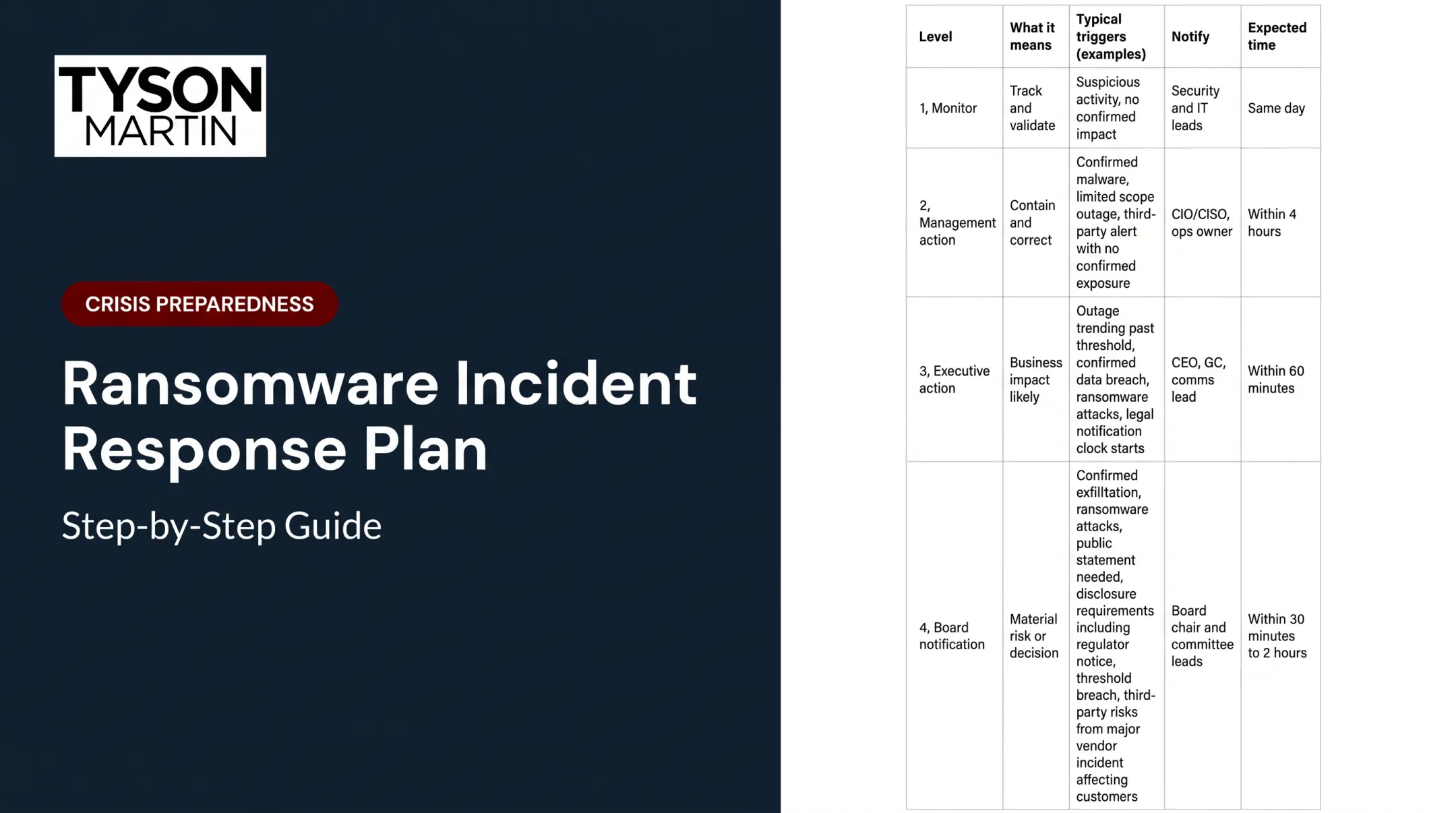
- Write escalation thresholds into the response plan, in dollars, downtime, data sensitivity, or legal exposure
- Keep call trees current, including after hours
- Set briefing cadence and confidence labels
- Bring legal and communications in early
- Run cross-functional tabletop exercises with timed injects, a decision log, a draft external statement, and an after-action report
Boards have room to improve here. A WSJ and NACD survey of 472 directors found fewer than half reported joining a cyber tabletop in the prior year.
Plain-English board reporting
Good updates cover:
- What changed and what is known
- What remains uncertain
- Which decisions are needed and who owns them
- How technical and business risk are trending
A first-hour escalation message should state what happened, what is impacted, what is being done next, and which decisions are needed.
When no executive owns it
Some organizations lack a dedicated executive owner. A board advisor or interim or fractional CISO can clarify governance, decision rights, escalation thresholds, board reporting, and a practical readiness plan. Tyson Martin works with boards and executive teams to close that gap and pressure-test the response and oversight model.
Real-World Example: Colonial Pipeline (2021)
Colonial Pipeline shows the two roles pulling apart.
The event and technical response. According to CEO Joseph Blount's Senate testimony, an employee found a ransom note on an IT system just before 5 a.m. EDT on May 7. Colonial halted pipeline operations to isolate the attack and keep it from reaching operational technology while the scope was unknown.
The executive decisions. Blount said he chose to pay so the company would have every restoration tool available. The Department of Justice identified a May 8 payment of approximately 75 bitcoin. That is a business call about risk, cash, and speed, not a technical one.
Verified milestones:
- May 8: company update disclosed ransomware and a halt to all pipeline operations
- May 12: restart began at about 5 p.m. ET
- May 13: the entire pipeline restarted, with product delivery to all served markets
- June 7: DOJ announced seizure of 63.7 bitcoin, then worth about $2.3M
Public reporting does not include a single total financial impact or enterprise-wide downtime figure. Recovery milestones and a regulatory materiality clock also measure different endpoints.

The takeaway: the strongest structures let technical teams focus on containment while executives make business decisions using timely, validated information.
Boards, CEOs, COOs, and security leaders who want to test their escalation thresholds, decision rights, and joint exercise program can review them with an experienced advisor like Tyson Martin.
Conclusion
Incident response and crisis management are not interchangeable, and neither replaces the other. Incident response answers how the organization will understand and control the event. Crisis management answers how it will protect the business and its stakeholders while that work continues.
For boards and executive teams, the payoff is clear ownership, faster escalation, cleaner communication, fewer surprises, and decisions that hold up when facts are incomplete.
Coordinated readiness, tested plans, and technical execution tied to business priorities matter more than treating either discipline as a substitute for the other.
Frequently Asked Questions
Is an incident response plan the same as a disaster recovery plan?
No. Incident response covers detection, investigation, containment, and eradication. Disaster recovery restores systems, data, and services after disruption. The plans should connect but serve different purposes.
What is crisis management and incident response?
Incident response is the tactical handling of a specific event. Crisis management is executive coordination of the broader business, legal, operational, and stakeholder consequences.
What is the difference between an incident and a crisis?
An incident is an adverse event requiring response. A crisis is an incident whose actual or potential impact exceeds normal authority and demands enterprise-level decisions.
What are the key C's in crisis management and incident response?
No standardized authoritative list of C's exists. FEMA's ICS definition uses command, control, and coordination, and cyber planning guidance treats integrated communications as foundational.
What are the four types of incidents?
Categories vary by framework. CISA defines four recoverability categories: Regular, Supplemented, Extended, and Not Recoverable. They drive triage by showing how much outside help and time recovery will need, which signals when to escalate.
What is the difference between ICS and IMS?
FEMA defines the Incident Command System as a standardized approach to command, control, and coordination of on-scene incident management. Its broader system, NIMS, also includes emergency operations centers and multiagency coordination. Either structure sets roles, authority, and escalation during a major incident.